“Absolutely”
Παντελῶς makes the claim total. The correction is not merely small or negligible; none is required.
Henry Neville · Ambassador to France · 1599
A painted solar diagram makes a precise moral claim: in Henry Neville, apparent and true position require no correction.
First operate the astronomy. Then follow the astronomy as it becomes an argument about character.
Operate the model ↓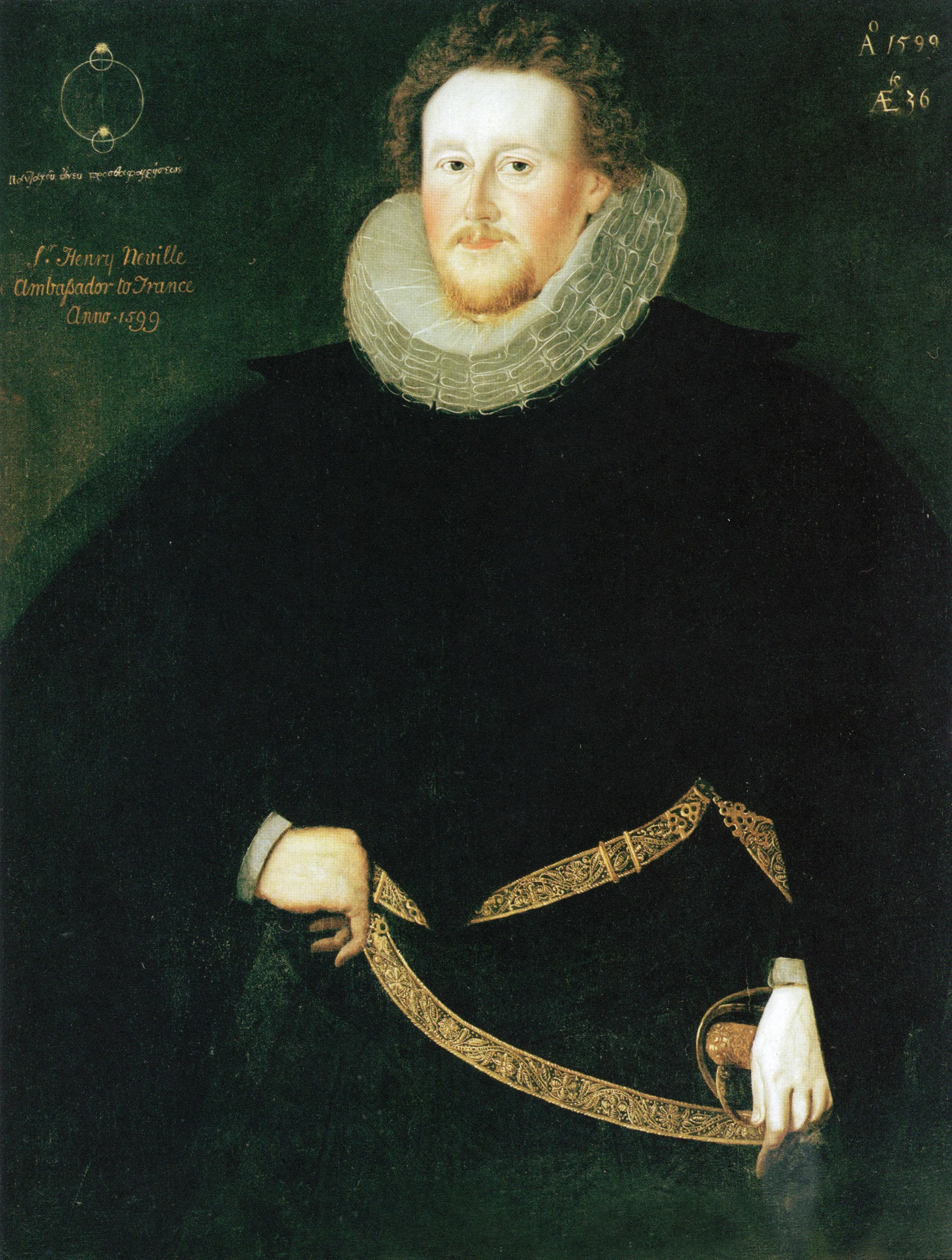
At upper left, Neville’s portrait pairs a line of Greek with an exact astronomical construction. The picture does not just say “astronomy.” Its geometry has to work for its message to work.
The device is Ptolemy’s alternative epicyclic solar model. It shows the two exceptional instants when the sun’s calculated position and observed position fall on a single line.
This is a picture-and-motto construction whose parts explain one another. The diagram supplies the technical fact; the Greek states its consequence. A viewer has to understand both before the moral claim becomes visible.
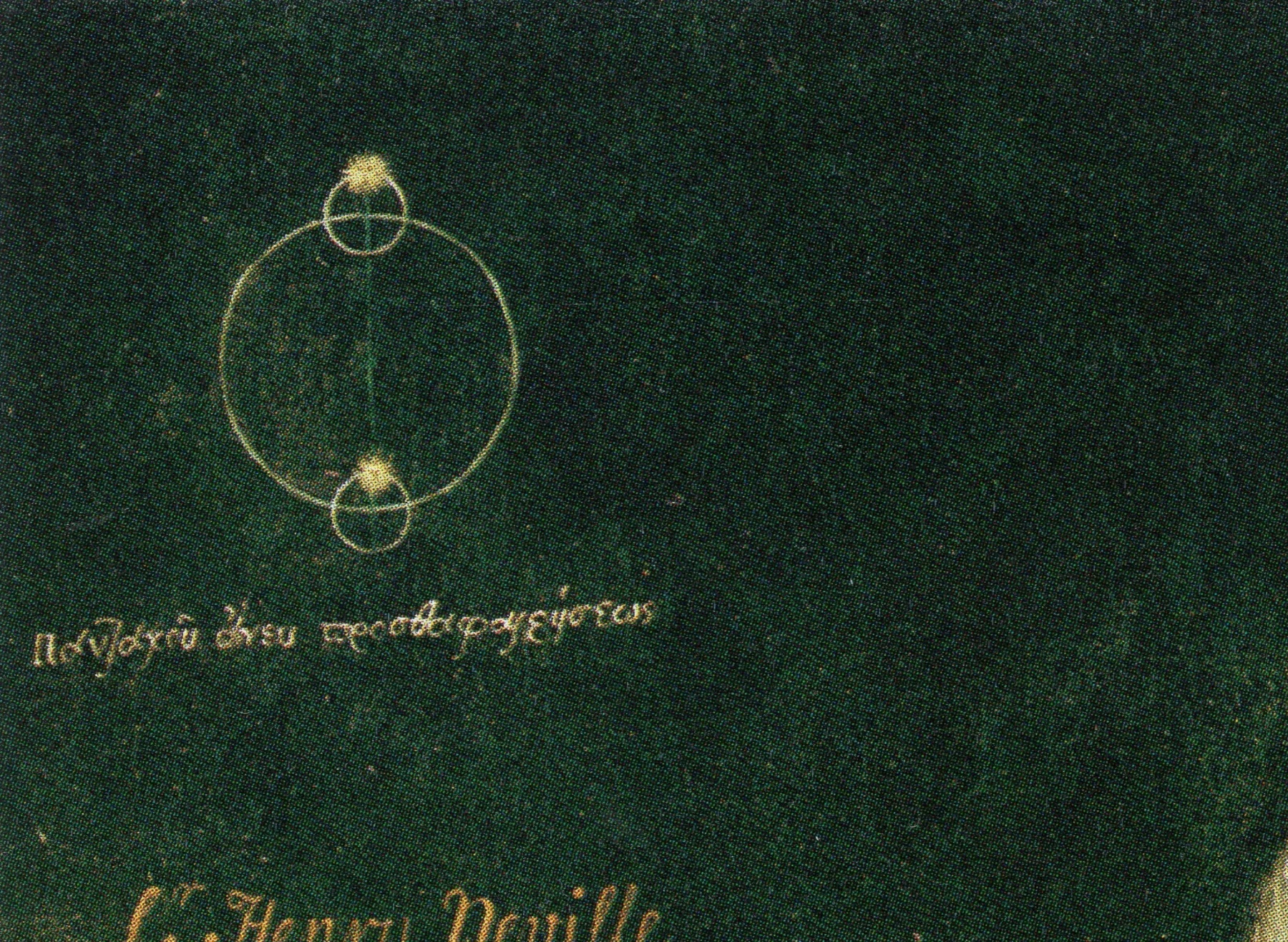
Sun at apogee. The upper small circle places the painted sun at the outer extreme of the construction. From the observer’s center, sun and epicycle center lie on one direction.
The inscription states in words what the astronomical diagram demonstrates in geometry: at apogee and perigee, no correction separates the mean sun from the true sun.
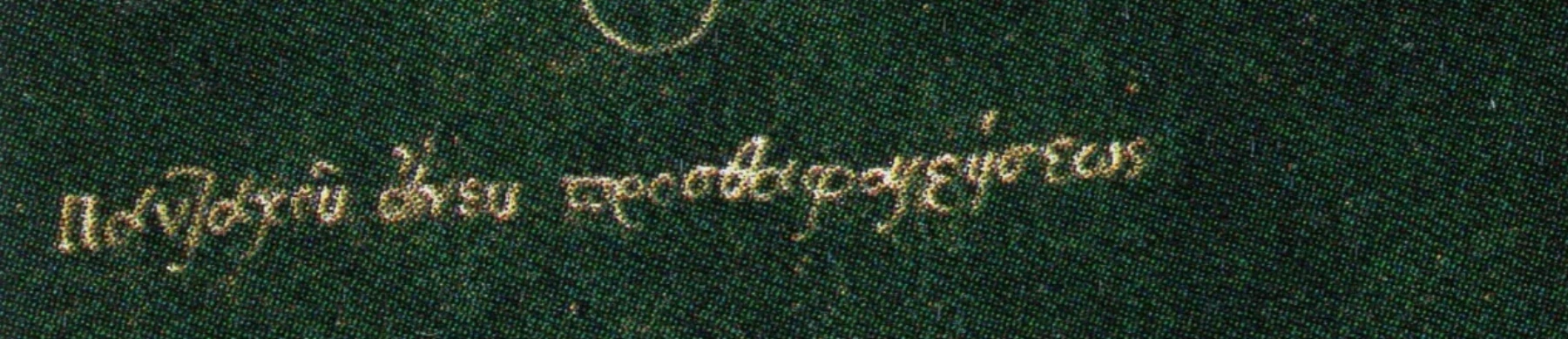
Παντελῶς ἄνευ προσθαφαιρέσεως
“Absolutely without prosthaphaeresis.”
The three-word sentence makes an absolute claim: the astronomical correction is not merely small; it is absent.
Παντελῶς makes the claim total. The correction is not merely small or negligible; none is required.
ἄνευ denies the correction verbally; the painted apogee and perigee configurations show the two places where it vanishes geometrically.
προσθαφαίρεσις names the astronomer’s adjustment between a calculated mean position and the observed true position: the angle added or subtracted to move from one direction to the other.
Drag the sun away from the vertical line. Gold marks the uniformly moving mean sun; red marks the observed true sun. The angle between their rays is the astronomical correction called prosthaphaeresis.
The mean sun is a device of orderly calculation: it advances at a perfectly uniform rate, making its future positions easy to tabulate. It is not a second body in the sky. It is a regular reference position—a clockwork sun against which the observed sun can be compared.
The observed or true sun does not generally fall in the same direction as that uniform reference. An astronomer begins with the mean position and then adds or subtracts an angular adjustment to reach the true position. That adjustment is the astronomical prosthaphaeresis.
Start at apogee, where the readout is zero. Drag toward quadrature: the gold and red rays open and the correction grows. Continue to perigee: the rays close again. The graph records the same cycle across a complete orbit.
The reconstruction enlarges the eccentricity so the changing angle remains easy to see.
The crucial distinction is between distance and direction. At most points, the epicycle displaces the true sun partly sideways from the mean position. Seen from the observer, that sideways component opens an angle between the two rays, and an angular correction is required.
At apogee and perigee, the displacement runs directly along the observer’s sight-line. Moving a body nearer or farther on the same ray changes its distance without changing its direction. These are therefore the two exceptional instants when mean and true position coincide. They are the two instants the portrait chooses to paint.
The eye at the center. Every “position” is a direction measured from here.
The large circle carrying the center of the smaller epicycle at uniform speed.
The calculated direction from observer to epicycle center—the gold ray.
The direction from observer to the sun itself—the red ray.
Apogee, center, and perigee lie on one line. Here the two directions coincide.
Move the red sun toward or away from the observer along the gold ray. Its distance changes, but its direction does not. Then add a sideways displacement: the rays separate and a correction angle appears.
The portrait’s conceit is compact because it expects a learned viewer to move from the painted object, through the astronomy, to its claim about Neville’s character.
The portrait supplies three things: an astronomical construction with upper and lower solar configurations, a line of Greek, and Neville’s identification as ambassador to France. Together they form a single proposition.
The device works like an impresa-like pairing of image and motto: neither part is complete by itself. The painted geometry supplies a technical situation; the inscription names it. A trained viewer then has to transfer the relation between mean and true celestial positions into the moral vocabulary of public appearance and inward character.
Its unusual force comes from exactness. A generic globe or book could advertise learning. This construction must be correct for the conceit to work. The claim of integrity is performed by geometry that a knowledgeable viewer can check.
An ambassador is professionally responsible for representation, report, and credibility. By identifying Neville with the French embassy and presenting his apparent and true positions as requiring no correction, the portrait makes a pointed promise: what he presents does not need to be privately adjusted.
An ancient astronomical term: the amount added to or subtracted from a mean celestial position to obtain its true position. The object itself fixes this sense because it paints positions, sight-lines, apogee, and perigee.
A sixteenth-century calculating technique transformed a difficult multiplication into additions and subtractions with the help of trigonometric identities and prepared tables. It shares a name with the astronomical correction, but it is not what Neville’s diagram depicts.
The two uses are historically and mathematically separate apart from their shared language of adding and subtracting. Neville’s diagram fixes the ancient astronomical sense. His intellectual connections to Savile and Wittich explain how this unusually technical word belonged to his intellectual world; they do not turn the painted construction into a second computational cipher.
This demonstration explains the other, computational use of the word. Change either angle: both routes still reach the same number.
With pencil and paper, multiplying long decimals is the laborious step.
Historically, prepared trigonometric tables supplied the cosine values. The arithmetic left to the calculator was addition, subtraction, and division by two.
The verbal resemblance—adding and subtracting—is the only connection established here. The painted portrait depicts the astronomical correction, not this computational method.
Παντελῶς ἄνευ προσθαφαιρέσεως“Absolutely without prosthaphaeresis”: no angular correction separates mean position from true position at the two painted apsides.
ne vile velis
The family’s canting motto—“wish nothing base”—and the portrait’s zero-correction astronomy express the same ideal of moral integrity through different languages.
Move the sun; watch the correction vanish.
The interactive model makes the portrait’s construction visible: the mean and true rays separate around the orbit and coincide at apogee and perigee.
Object: 1599, oil on wood, Audley End House, private collection of Lord Braybrooke; attributed by GrECI to Marcus Geeraerts the Younger with a question mark.
Image: The high-resolution portrait image preserves the astronomical diagram and the three-word Greek inscription at upper left.
Reading: The inscription and the diagram state the same condition in words and geometry: absolutely no correction at the apsides.